The Prompt Report
The AI creative toolbox just got a serious upgrade. Here’s what I’m trying to keep up with this month in the world of “Everything is new everyday”.

Nano Banana on steroids
Nano Banana Pro, the next-gen image generation and editing model from Google DeepMind / Gemini 3 Pro, is out. It delivers 4 K-ready, high-fidelity visuals with better image editing controls, clean in-image text, world knowledge built-in (so infographics, diagrams, campaign assets, etc., make more sense), and full support inside tools like Adobe Photoshop, Adobe Firefly, and Google’s own apps. Workspace Updates Blog+3The Verge+3blog.google+3
What used to be a meme-creator is now a fully fledged creative tool for professionals, with close to campaign-ready visuals.
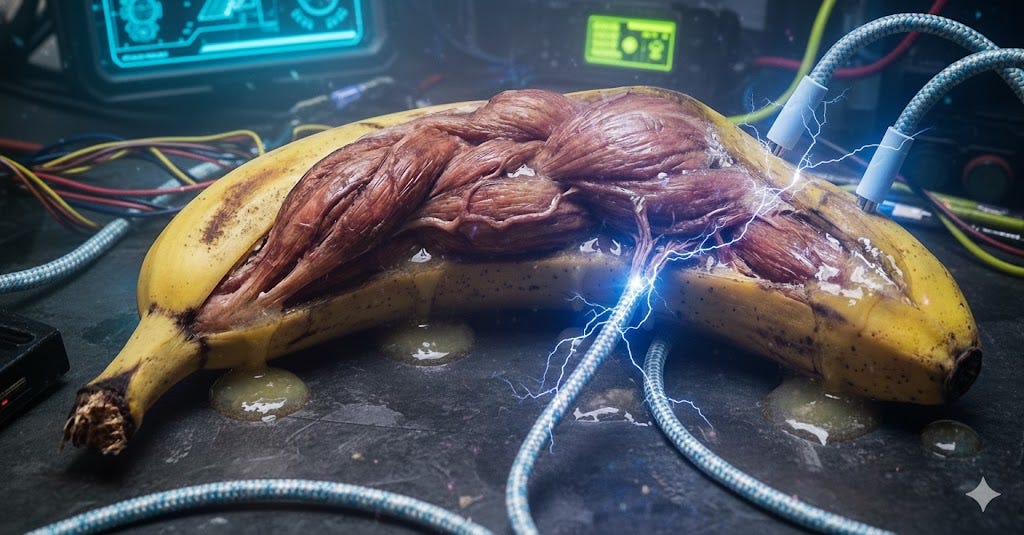
Just when you thought bananas couldn’t look more phallic, Nano banana Pro exceeds your expectations with this representation of a banana on digital steroids.
Jono’s take: For anyone in creative, this feels like the moment when “AI mock-ups” stop looking like Sketch or Canva hacks and start looking like real deliverables. As a copywriter, I love nothing more than beating my Art Directors’ AI images in a deck, and this week that’s been the case as Nano Pro is just that good. Resisting the overwhelming urge to depict myself having lunch with the top tech billionaires, playing around it is truly impressive.
Generative AI is becoming the backbone of creative workflows, but strategy is more important than ever.
Across agencies and studios, AI is no longer just a flashy add-on: it’s starting to embed itself into actual creative workflows. Tools from design suites, video editors, and marketing platforms are integrating generative AI more deeply.
And yet: many AI projects still fail not for technical reasons, but because they lack clear goals or realistic metrics. Without strategy and intent, AI pilots end up stuck in “proof-of-concept limbo.”
Jono’s take: Just like advertising, the work is only as good as the brief. AI won’t automatically make you more creative, but if you treat it as part of the workflow (not a magic wand), you get the chance to move faster, explore more iterations, and maybe push into places you couldn’t before. We forget sometimes AI doesn’t actually understand what you’re asking, it just does a really good job of looking like it does, (and fawning over you in the process). In simple terms, we can think of strategy (at least in advertising) as a model’s prompt. The tighter and more detailed the prompts, the better, more aligned (on brief) your outcome will be. It’s like David Ogilvy famously said, “Give me the freedom of a tight prompt”.
The meta-AI economy is shifting: agents, automation, and infrastructure
Deeper AI infrastructure is creeping into everyday business, from automated agents to cloud-native chips; AI is turning from novelty to backbone. For example, some of the new agentic workflows announced this month replace “traditional chatbots” with AI agents capable of reasoning, acting, and coordinating tasks.
That matters for creatives too, once agents can manage project admin, file handling, rough drafts, and basic stuff, creatives get to focus on the weird, human, nuanced parts: storytelling, iteration, context.
Jono’s take: This is sort of like AI doing the plumbing, quietly powering everything behind the scenes, while we get to crack on with the fun stuff*. I think we’ll know we’ve hit AGI when AI can finally do timesheets.
*I’m sure plumbing is fun to some people, and in no way do I mean to denigrate it as a profession. Particularly given that I’ll probably have to apply to be a plumber in a few years.
Regulation and backlash hit creative work
South Korea has just mandated that AI-generated ads be clearly labelled starting in 2026 to protect consumers and market integrity.
Meanwhile, a high-profile AI Christmas ad from McDonald’s Netherlands was pulled after audiences found it uncanny and soulless. Critics called it “creepy,” prompting the brand to take it down entirely.
Jono’s take: In AI-driven creativity, there’s now a real tension between capability and conscience, between can and should. Even when the output lands, audiences can sense when the humanity goes missing.
Here’s the paradox: a human mistake in art feels soulful, but an AI mistake feels like a malfunction. Human imperfections give work life, AI imperfections remind us it’s not alive.
Final thought: Embrace the Creative OS.
We’re starting to see the contours of what’s being called Creative OS. A world where creative work is increasingly built across hybrid human + AI workflows. The difference this month: the tools are a lot more legitimate. Nano Banana Pro gives designers (and anyone really) fast prototyping power. Claude Opus 4.5 shows that AI can contribute at a professional engineering level. Infrastructure moves mean faster, cheaper scaling.
But, good creative AI requires context, strategy, and clarity. I’m betting that the winners next year will be those who treat AI as their co-worker with defined tasks, guardrails, and a sense of creative leadership.
I’m still nervous about what this does to entry-level creatives, but I’m more optimistic about what it could do for small teams and independent storytellers. As creatives, we’re at the beginning of something that might look like chaos (and I think it’s only going to get more chaotic), but it also feels a lot like opportunistic reinvention.
End prompt.